
Unexpected Condition Detector for Industrial Safety using Deep Generative Models
Date:
🧠 Overview
This talk presented our work on an Unexpected Condition Detector for industrial safety monitoring in robotic environments, developed within Use Case 3: Safe Interaction with Robots of the DistriMuSe EU Project.
The goal is to detect deviations from expected operating conditions in safety-critical robotic workspaces, where unexpected situations are difficult to define exhaustively and collect in advance.
Instead of relying on fully labelled abnormal data, the system is trained mainly on normal operating conditions and learns to identify unexpected situations through reconstruction-based anomaly detection.
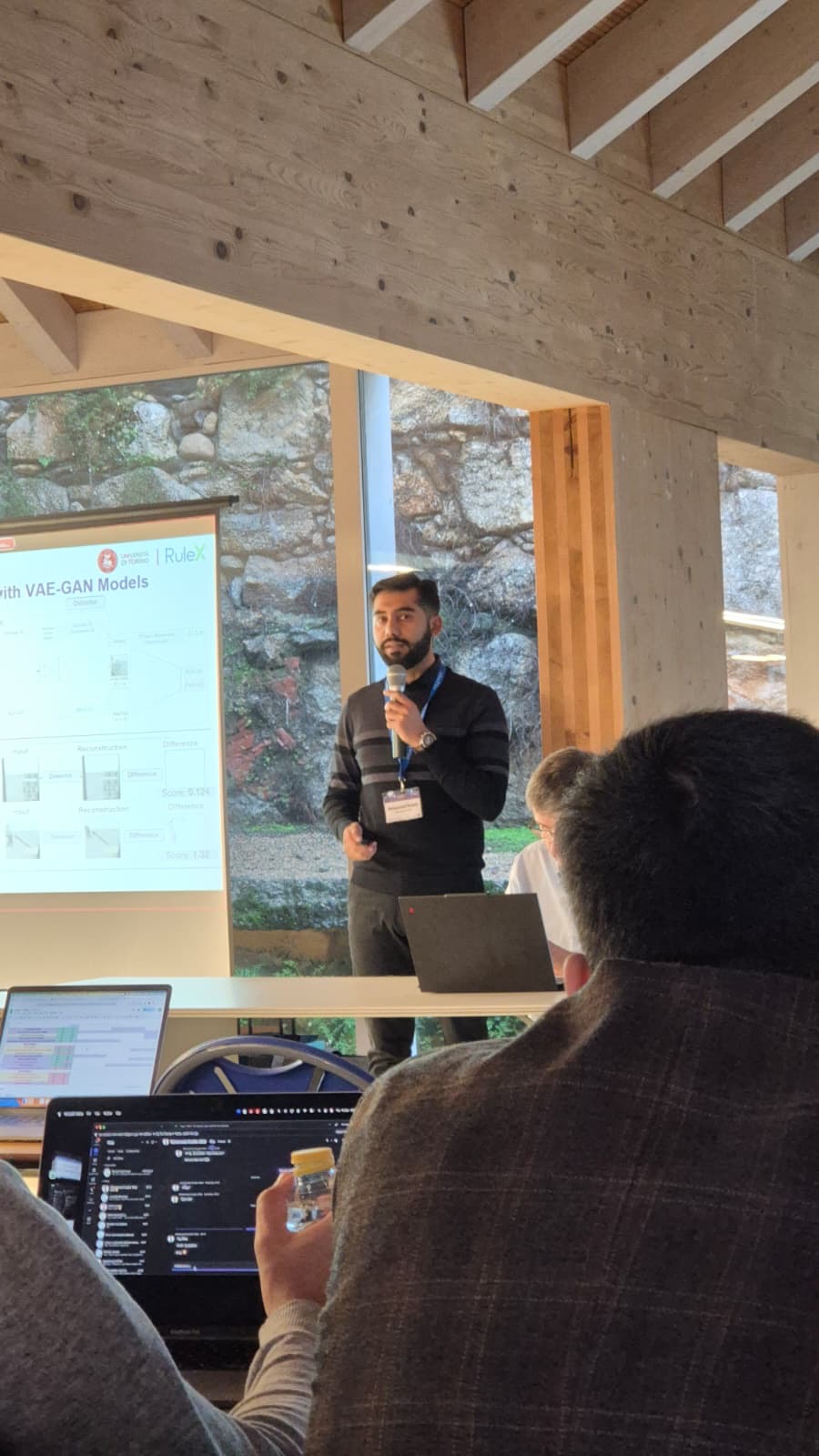
Oral Talk on VAE-GAN Models
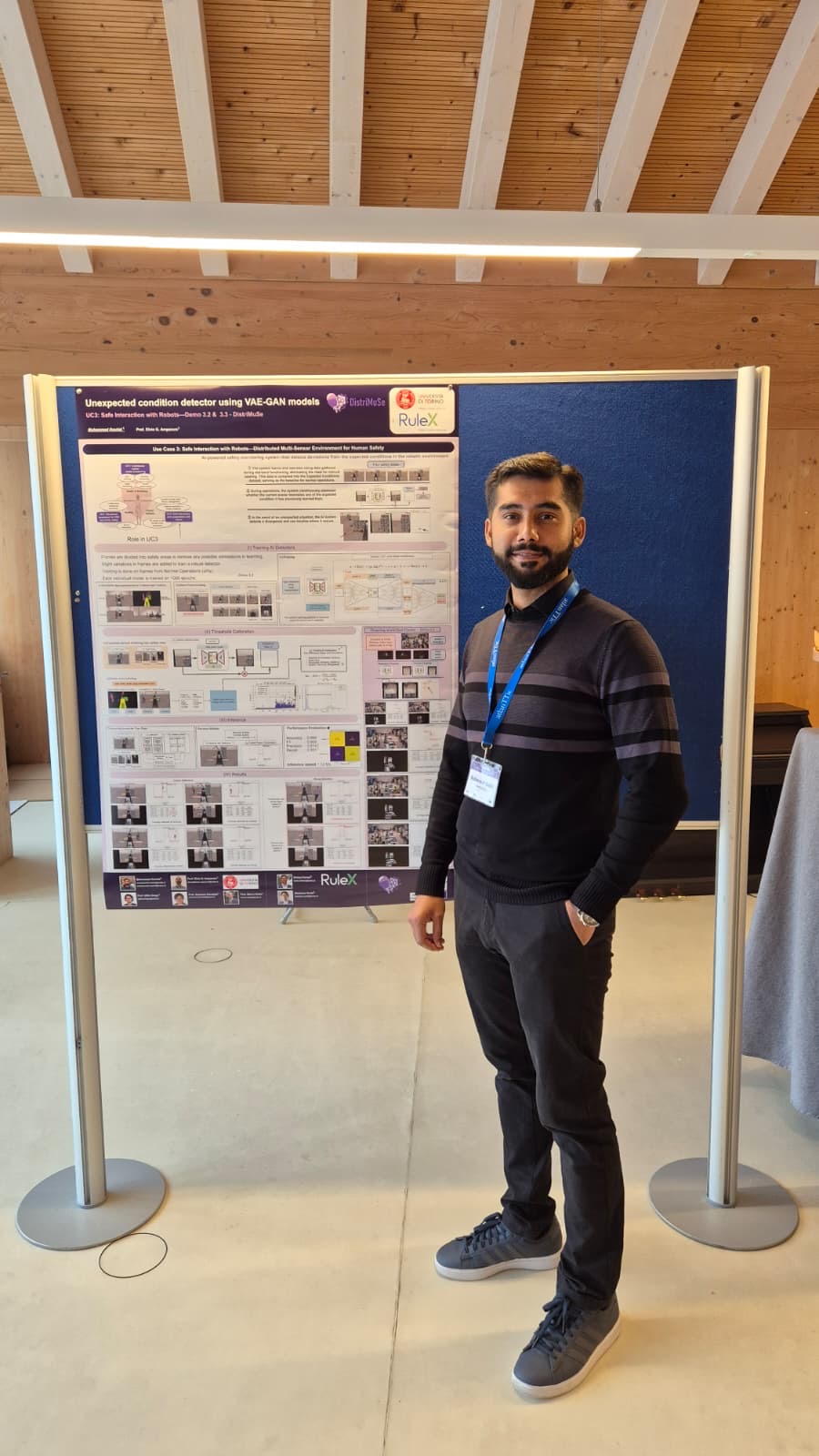
Poster Talk on VAE-GAN models
🎯 Motivation
In industrial robotic environments, unsafe or unexpected situations can occur in many different forms, such as:
- a person entering a restricted safety area,
- an object falling into the workspace,
- abnormal interaction near the robot arm or conveyor belt,
- deviations from expected human-robot collaboration patterns.
These situations are difficult to enumerate completely. Therefore, we use a semi-supervised anomaly detection strategy, where the model learns normal behaviour and detects deviations as unexpected conditions.
⚙️ Method: VAE-GAN Based Detector
The proposed detector is based on a Variational Autoencoder with Generative Adversarial Network components, referred to as a VAE-GAN detector.
The system learns to reconstruct normal visual patterns. During inference, unexpected situations produce higher reconstruction errors because they do not match the learned normal distribution.
The detector combines:
- VAE for learning a probabilistic latent representation,
- Autoencoder reconstruction for measuring visual deviations,
- GAN-based discriminator to improve reconstruction realism,
- difference maps to localize anomalous regions.
🏭 UC3 Safety Areas
The input frame is divided into multiple safety-relevant regions to avoid learning unrelated correlations across the scene.
The main monitored safety areas are:
- Robot Arm
- Conveyor Belt
- Pallet Left
- Pallet Right
A separate detector is trained for each safety area, allowing the system to produce both image-level and region-level anomaly decisions.
🔄 Pipeline
The complete pipeline consists of four main stages:
1. Training AI Detectors
Frames from normal operations are used to train one VAE-GAN detector per safety area.
Data augmentation is applied to introduce small variations and make the detector more robust to normal visual changes.
2. Threshold Calibration
After training, reconstruction errors are computed on validation data and calibrated using multiple difference scoring strategies.
The evaluation included 53 difference scoring methods, including pixel-wise, Euclidean, SSIM-based, and spatial-tolerance based scoring.
3. Inference
During inference, each incoming frame is divided into safety areas and processed by the corresponding detector.
The system computes:
- reconstruction output,
- difference map,
- anomaly score,
- normalized score,
- final normal/unexpected decision.
A normalized score below 1.0 is treated as normal, while a score above 1.0 indicates an unexpected condition.
4. Results and Visualization
The system produces both numerical anomaly scores and visual difference maps, helping identify where unexpected behaviour occurs inside the safety area.
📊 Experimental Results
The detector was evaluated on Demo 3.2 synthetic data and Demo 3.3 real Smart Robotics data.
Reported performance:
- Accuracy: 99.61%
- F1-score: 90.9%
- Precision: 87.4%
- Recall: 95.1%
- Inference speed: approximately 12 FPS
These results show that the system can detect unexpected conditions in real robotic environments while maintaining real-time inference capability.
🧪 Use Case Demonstrations
The talk included examples from the UC3 scenario, including:
- normal pallet interaction,
- unexpected person entering a restricted safety area,
- fallen object or unexpected item near the working area,
- correct and incorrect detections across safety regions.
These demonstrations highlight how the detector supports safety monitoring by identifying deviations from expected robotic workspace conditions.
🎯 Impact
This work contributes to the DistriMuSe UC3 objective of improving human safety in smart industrial environments through AI-powered monitoring.
The proposed approach shows that deep generative models can be used to detect unexpected conditions even when abnormal examples are limited or unavailable during training.
The key idea is to learn what is normal, then detect what deviates from it.
🏷️ Keywords
Anomaly Detection · VAE-GAN · Deep Generative Models · Industrial Safety · Smart Robotics · Human-Robot Interaction · DistriMuSe · Explainable AI · Safety Monitoring