
Acute Lymphoblastic Leukemia Classification: Deep Learning Techniques for Blood Diseases Diagnosis
Published in Journal of Computing & Biomedical Informatics, 2025
This work presents a deep learning-based approach for Acute Lymphoblastic Leukemia (ALL) classification using microscopic peripheral blood smear images. The study focuses on automatic classification of ALL and its subtypes to support early screening and assist healthcare professionals in laboratory diagnosis.
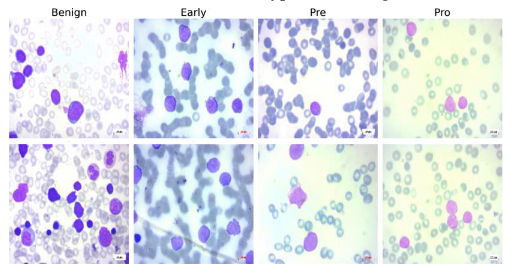
The proposed system uses a fine-tuned EfficientNetB3 model trained on a publicly available Kaggle dataset of ALL blood smear images. The dataset contains 3,256 peripheral blood smear images collected from 89 suspected ALL patients, including benign samples and malignant ALL subtypes such as Early Pre-B, Pre-B, and Pro-B.
Contributions 📃
In this study, we present:
- A deep learning framework for classifying Acute Lymphoblastic Leukemia from microscopic blood smear images.
- A fine-tuned EfficientNetB3 model for multi-class ALL subtype classification.
- A complete pipeline covering data preprocessing, model training, learning-rate tuning, and classification.
- Evaluation using multiple metrics including accuracy, precision, recall, F1-score, ROC curve, confusion matrix, Cohen’s kappa, MCC, and F2-score.
- Experimental results showing 99.84% classification accuracy after 20 epochs.
Method Summary
The proposed workflow consists of three main stages:
Data Preprocessing
Peripheral blood smear images are prepared, labels are checked, and data loaders are created for training and validation.Model Structuring and Training
A fine-tuned EfficientNetB3 model is trained using mixed-precision training and the one-cycle learning-rate policy.Classification and Evaluation
The trained model is evaluated using standard classification metrics and visual tools such as confusion matrix, ROC curve, and accuracy/error-rate plots.
Dataset and Model
| Component | Details |
|---|---|
| Dataset | Acute Lymphoblastic Leukemia blood smear image dataset |
| Images | 3,256 PBS images |
| Patients | 89 suspected ALL patients |
| Classes | Benign and malignant ALL subtypes |
| ALL Subtypes | Early Pre-B, Pre-B, Pro-B |
| Model | EfficientNetB3 |
| Training | Fine-tuning with mixed precision |
| Accuracy | 99.84% |
Authors ✍️
| Sr. No. | Author Name | Affiliation |
|---|---|---|
| 1. | Faisal Yaseen | Department of Computer Science, Bahaudin Zakriya University, Multan, Pakistan |
| 2. | Muhammad Rashid | Department of Computer Science, University of Torino, Italy |
| 3. | Muhammad Yasir Shabir | Department of Computer Sciences, University of Kotli, Pakistan |
| 4. | Muhammad Attique Khan | Prince Mohammad bin Fahd University, AlKhobar, Saudi Arabia |
| 5. | Nazar Hussain | Department of Management Information Systems, King Saud University Riyadh, Saudi Arabia |
Keywords 🔍
Acute Lymphoblastic Leukemia · Blood Disease Diagnosis · Deep Learning · EfficientNetB3 · Medical Image Classification · Computer Vision
📖 Citation
@article{yaseen2025acute,
  author  = {Yaseen, Faisal and Rashid, Muhammad and Shabir, Muhammad Yasir and Khan, Muhammad Attique and Hussain, Nazar},
  title   = {Acute Lymphoblastic Leukemia Classification: Deep Learning Techniques for Blood Diseases Diagnosis},
  journal = {Journal of Computing \& Biomedical Informatics},
  volume  = {9},
  number  = {01},
  year    = {2025},
  url     = {https://www.jcbi.org/index.php/Main/article/view/1033}
}