
ADVIS-UniGra: RGB Anomaly Detection for Safe Human–Robot Collaboration
Published:
ADVIS-UniGra (Anomaly Detection and Visual Intelligence System) is an RGB-based anomaly detection framework developed for monitoring safety-critical events in collaborative robotics environments.
The framework was developed as a validation application on top of the synthetic industrial environment created within the European DistriMuSe project. The objective is to automatically identify unsafe situations, unexpected human presence, and abnormal operating conditions that may affect safe human–robot collaboration.
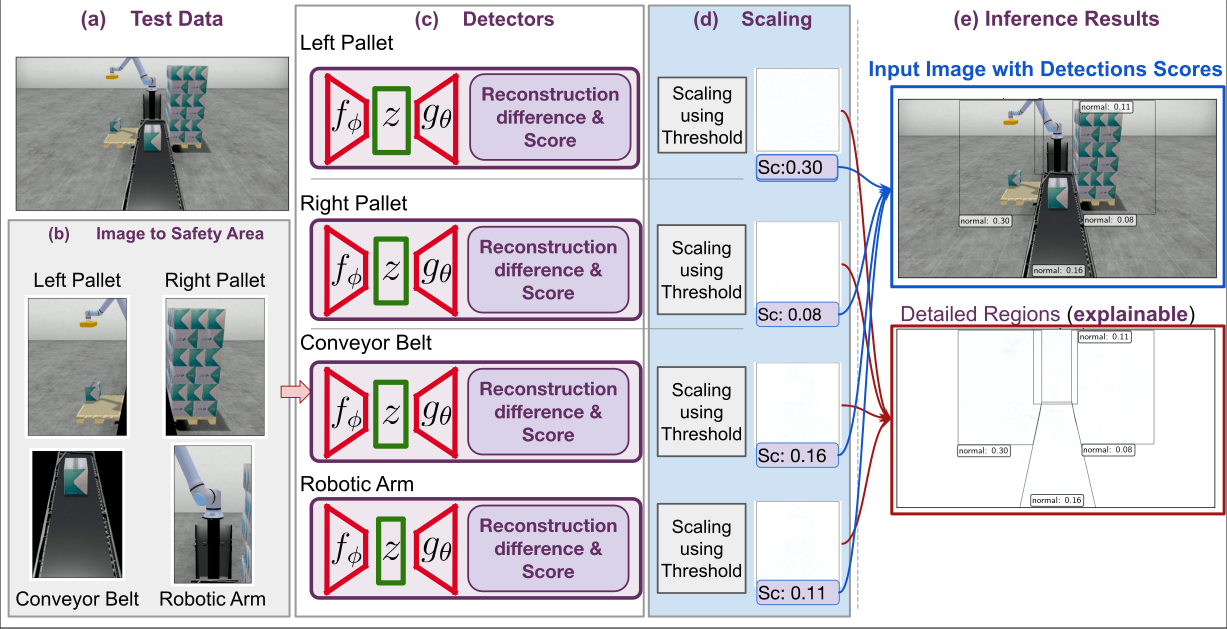
ADVIS Full Framework and Results
GitHub Repository Generated Dataset
Project Overview
Modern collaborative robotics environments require continuous monitoring to ensure that humans and robots can safely share the same workspace.
Traditional rule-based systems struggle when unexpected situations occur. ADVIS addresses this challenge using anomaly detection techniques that learn normal operating conditions and automatically identify deviations from expected behavior.
The framework focuses on:
- Human safety monitoring
- Collaborative robotics
- Industrial palletizing environments
- One-class anomaly detection
- Explainable AI for anomaly analysis
- Real-time industrial deployment
Background
The work was carried out within the context of the European DistriMuSe project.
A synthetic collaborative robotics environment was developed by project partners to simulate industrial palletizing operations involving:
- Collaborative robots
- Human operators
- Conveyor belts
- Pallets
- Safety-critical zones
My contribution focused on developing the anomaly detection application and validating the usefulness of the generated synthetic data for industrial AI applications.
My Contributions
Project Deliverables:
Contributed to deliverables:
- D5.3 Results of the first evaluation and stage 2 feedback:
- Section: Unexpected situations detection and localization by UniTO and RULEX (section 5.1.2.4 of D5.3)
- D3.6 First set of machine learning algorithms:
- D3.5 Privacy-preserving trustworthy ML solutions:
- Section: Building Trustworthiness, Achieving Trustworthiness by Explainability and Explainable AI for Computer Vision with Robotics Focus by using ShapBPT for Robotics.
- Section 2: Achieving Trustworthiness by System Quality Improvement - 2.2.2 Unexpected Condition Detector:
- D4.6 Second release of the reference implementation for the distributed platform
- Section: SW-025 Unexpected Condition Detector - for communication between application and worker nodes.
- D4.5 Updated requirements and design of the distributed platform,design and simulation tools:
- SW-025 - AI-powered anomaly detection system
RGB-Based Anomaly Detection Application
Developed the complete RGB anomaly detection pipeline used as the validation use case.
Dataset Evaluation and Feedback
Evaluated multiple releases of the synthetic dataset and provided feedback regarding:
- Visibility of anomalies
- Camera placement
- Safety-zone coverage
- Dataset suitability for anomaly detection
- Annotation quality
- Failure cases
- Difficult operating scenarios
Safety-Area Monitoring
Designed a monitoring strategy based on operational safety areas instead of processing the entire image as a single scene.
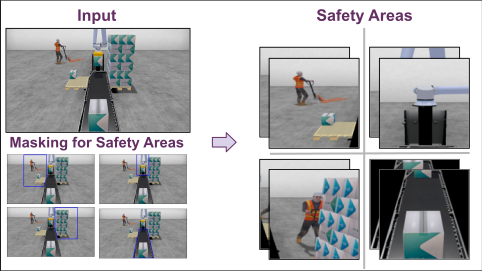
ADVIS Data Preproceesing
Area-Specific Models
Implemented dedicated VAE-GAN models for each monitored safety area.

ADVIS - VAE-GAN Model Architecture
Threshold Calibration
Developed an anomaly score calibration framework to improve robustness and reduce false alarms.
Explainability
Generated anomaly maps and visual explanations to support operator understanding and trust.
Safety Monitoring Areas
The industrial scene is decomposed into operationally meaningful safety zones.
| Safety Area | Description |
|---|---|
| PLeft | Left pallet area |
| PRight | Right pallet area |
| RoboArm | Robot operating zone |
| ConvBelt | Conveyor belt monitoring area |
Each area is monitored independently using a dedicated anomaly detection model.
Benefits include:
- Improved interpretability
- Localized anomaly reporting
- Easier debugging
- Better threshold calibration
System Pipeline
Input RGB Frame
↓
Safety Area Extraction
↓
Image Preprocessing
↓
128×128 Input Generation
↓
Area-Specific VAE-GAN
↓
Image Reconstruction
↓
Difference Map
↓
Anomaly Score
↓
Threshold Calibration
↓
Normal / Unexpected Decision
Deep Learning Architecture
The anomaly detector is based on a Variational Autoencoder Generative Adversarial Network (VAE-GAN).
Each detector contains:
Encoder
Transforms RGB images into a compact latent representation.
Latent Space
Captures the normal operating characteristics of each safety area.
Decoder
Reconstructs the original image from the latent representation.
Discriminator
Improves reconstruction quality by encouraging realistic outputs during training.
Training Strategy
The framework follows a one-class learning approach.
Training uses only:
- Normal operating conditions
- Safe robot behavior
- Authorized human activities
The model never sees anomalous events during training.
During inference:
- Normal patterns are reconstructed correctly.
- Abnormal patterns generate reconstruction errors.
- Reconstruction errors become anomaly scores.
Threshold Calibration Framework
A major contribution of ADVIS is the calibration framework.
Instead of relying on a single anomaly score, multiple scoring functions are evaluated.
Supported approaches include:
- L1 distance
- L2 distance
- SSIM
- RAVI
- Tolerance-Aware Anomaly Score (TAAS)
The best-performing score is selected individually for each monitored area.
Tolerance-Aware Anomaly Score (TAAS)
Industrial environments often contain:
- Small motions
- Blur
- Misalignment
- Reconstruction artifacts
Traditional pixel-wise scores may produce false alarms.
TAAS introduces local spatial tolerance by allowing pixels to match nearby reconstructed pixels rather than requiring exact correspondence.
Benefits:
- Reduced false positives
- Increased robustness
- Improved anomaly separation
- Better industrial applicability
Explainable AI
The framework was designed with explainability in mind.
Generated outputs include:
Reconstruction Maps
Visual comparison between original and reconstructed images.
Difference Maps
Pixel-level residual information.
Anomaly Maps
Heatmaps highlighting suspicious regions.
Temporal Analysis
Evolution of anomaly scores over time.
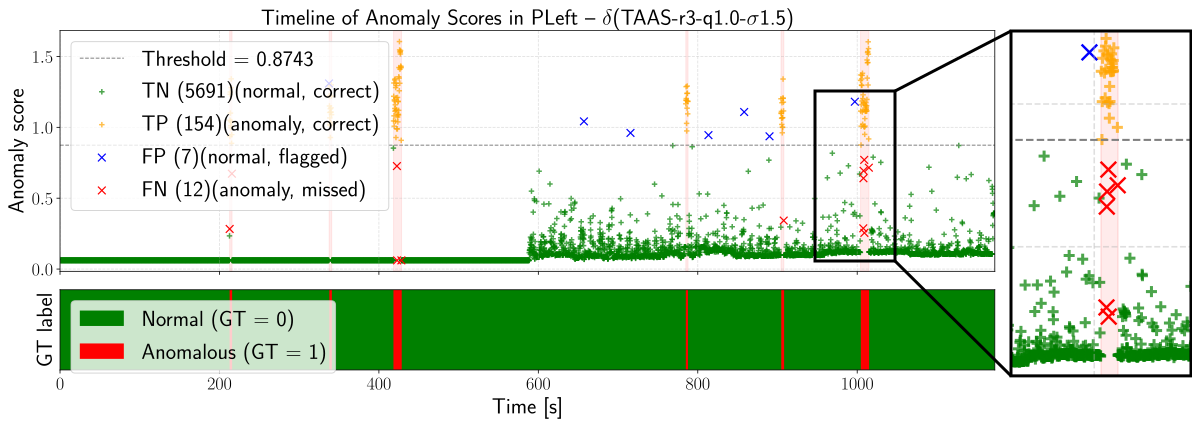
ADVIS Temporal Alignment of Detected Anomalies
These visualizations help engineers understand:
- Where the anomaly occurred
- Why the alert was triggered
- Whether the detection is trustworthy
Dataset Validation
The synthetic dataset itself was developed by project collaborators.
My role was to evaluate the dataset from the perspective of anomaly detection and provide continuous feedback during development.
Key validation questions included:
- Are anomalies visible?
- Are camera views informative?
- Can one-class models learn meaningful patterns?
- Are annotations reliable?
- Do anomaly maps align with human intuition?
The resulting experiments demonstrated that synthetic data can effectively support industrial anomaly detection research.
Experimental Results
The final system achieved strong performance across monitored safety areas.

ADVIS - Sample Results
Overall Performance
| Metric | Result |
|---|---|
| Accuracy | 99.61% |
| Precision | 87.4% |
| Recall | 95.1% |
| F1-score | 90.9% |
| Runtime | ~12.5 FPS |
Area-Level Results
| Area | Accuracy | Precision | Recall | F1 |
|---|---|---|---|---|
| PLeft | 99.6% | 94.5% | 93.9% | 94.2% |
| PRight | 99.8% | 97.1% | 80.9% | 88.3% |
| RoboArm | 98.9% | 25.9% | 84.0% | 39.6% |
| Overall | 99.6% | 87.4% | 85.1% | 90.9% |
Key Findings
- Synthetic industrial data can be effectively used for anomaly detection.
- Safety-area decomposition improves interpretability.
- Area-specific models outperform global detectors.
- Threshold calibration is essential.
- Explainable anomaly maps support trust and debugging.
- Real-time monitoring is feasible.
Open Source
The complete implementation is publicly available.
Related Publication
Simulation-Based Multimodal Dataset Creation for Industrial Collaborative Robotics. Application to RGB Anomaly Detection
José M. Herrera-Vera, Muhammad Rashid, Enrico Ferrari, Eduardo Ros, Elvio Amparore, Jesús A. Garrido
Related Research
This work builds upon previous research activities in explainable anomaly detection and trustworthy AI.
- Can I Trust My Anomaly Detection System? A Case Study Based on Explainable AI
- ShapBPT in Perspective: A Consolidated Review and an eXplainable Anomaly Detection Case Study
- ShapBPT: Image Feature Attributions using Data-Aware Binary Partition Trees
Future Directions
Potential future improvements include:
- RGB + LiDAR fusion
- Multimodal anomaly detection
- Vision-Language Models
- Sim-to-real transfer learning
- Foundation models for industrial monitoring
- Human-in-the-loop anomaly verification
- Edge AI deployment
Citation
@misc{rashid2026advisunigra, title={ADVIS-UniGra: RGB Anomaly Detection for Safe Human-Robot Collaboration}, author={Rashid, Muhammad and Herrera-Vera, Jose M. and Garrido, Jesus A. and Amparore, Elvio and Ferrari, Enrico}, year={2026}, howpublished={GitHub Repository}, url={https://github.com/rashidrao-pk/advis_distrimuse_unito} }