
AI on Edge Devices
Published:
This project investigates how deep learning models can be optimized and deployed on resource-constrained edge devices, with a particular focus on TensorFlow Lite, post-training quantization, and Raspberry Pi-based inference.
The objective is to move AI inference closer to the data source, reducing dependence on cloud infrastructure while improving latency, privacy, and deployment flexibility.
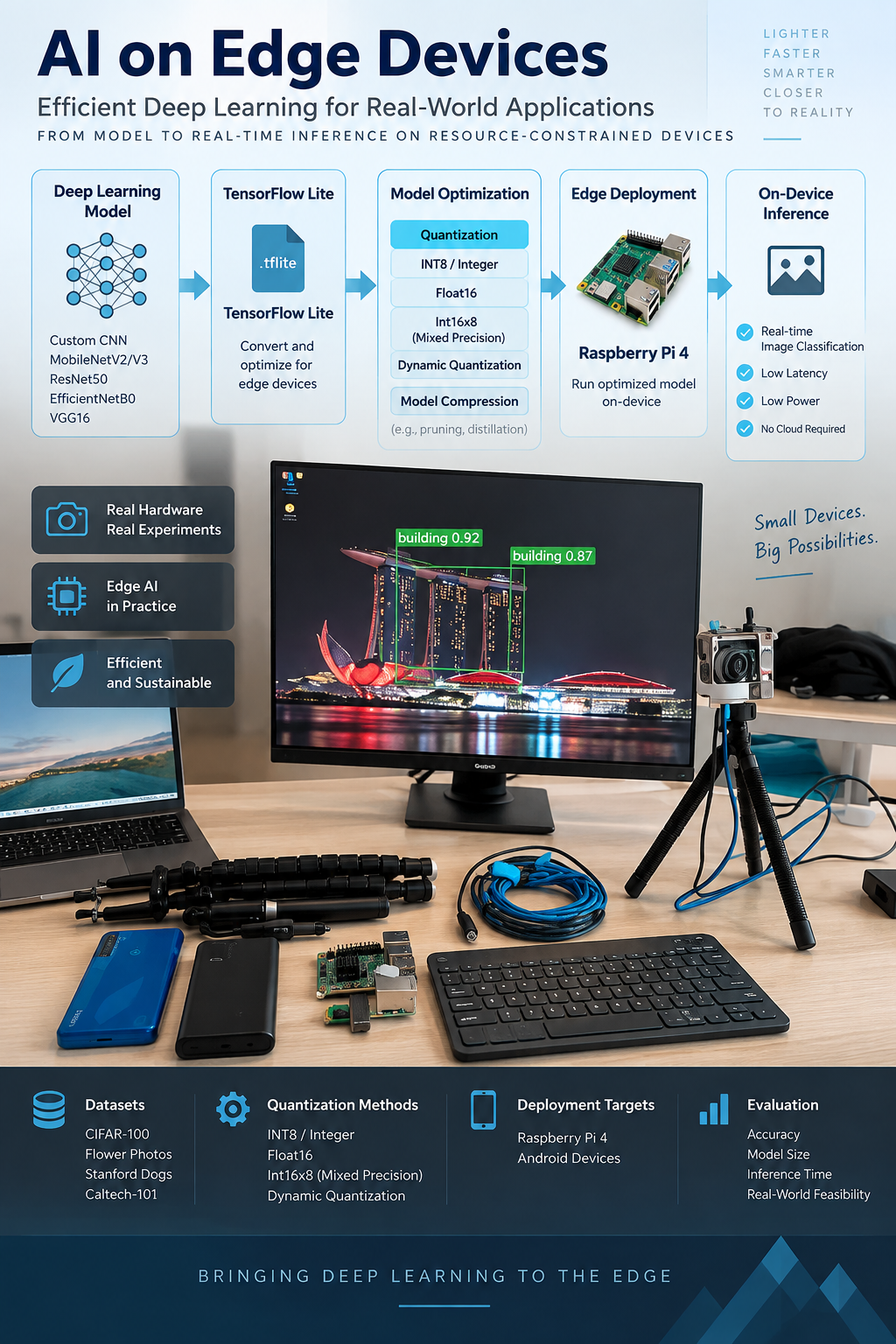
Edge AI Pipeline
The project follows an end-to-end deployment workflow:
Deep Learning Model → TensorFlow Lite → Quantization → Edge Device → On-Device Inference
Models are first trained or fine-tuned using TensorFlow/Keras and then converted to the TensorFlow Lite (.tflite) format for deployment on resource-constrained hardware.
Several post-training quantization strategies are investigated:
- INT8 / Integer Quantization
- Float16 Quantization
- Int16×8 Mixed-Precision Quantization
- Dynamic Range Quantization
- Dynamic Quantization with Float Fallback
These techniques reduce model storage and computational requirements while attempting to preserve predictive performance.
Models and Datasets
The experiments cover both a custom CNN and established deep-learning architectures:
- Custom CNN
- MobileNetV2
- MobileNetV3
- ResNet50 / ResNet50V2
- EfficientNetB0
- VGG16
The models were evaluated across image-classification datasets including:
- CIFAR-100
- Flower Photos / Oxford Flowers
- Stanford Dogs
- Caltech-101
This makes it possible to study how optimization behaves across architectures with different computational and memory requirements.
Raspberry Pi Deployment
A major component of the project is moving beyond desktop benchmarking and executing the optimized models on real edge hardware.
The quantized TensorFlow Lite models were deployed and evaluated on a Raspberry Pi 4 Model B, with additional experiments targeting Android devices.
The deployment workflow evaluates:
- model size,
- classification accuracy,
- inference latency,
- memory requirements,
- and practical feasibility of on-device inference.
This provides a realistic assessment of the trade-off between model performance and computational efficiency.
Quantization Results
One representative experiment uses a custom CNN trained on CIFAR-100.
| Model | Accuracy | Model Size |
|---|---|---|
| Original | 69.97% | 58.00 MB |
| Dynamic Quantization | 68.21% | 15.49 MB |
| Integer Quantization | 68.11% | 15.54 MB |
| Float16 Quantization | 67.20% | 30.83 MB |
| Int16×8 Quantization | 68.11% | 28.99 MB |
Dynamic quantization therefore reduced the model from 58 MB to 15.49 MB while retaining 68.21% accuracy, illustrating the practical accuracy–compression trade-off required for Edge AI deployment.
Model Compression
The current implementation primarily investigates post-training quantization (PTQ).
Additional compression techniques such as network pruning, knowledge distillation, and quantization-aware training provide natural extensions for further reducing computational and memory requirements.
Why Edge AI?
Running inference directly on edge devices provides several practical advantages:
- Lower latency — inference occurs close to the sensor.
- Reduced cloud dependency — models can operate locally.
- Improved privacy — raw data does not necessarily need to leave the device.
- Reduced bandwidth requirements — only predictions or selected information need to be transmitted.
- Deployment on low-cost hardware — optimized models can run on devices such as Raspberry Pi.
Applications
The resulting workflow can support applications including:
- Embedded computer vision
- Smart cameras
- Industrial IoT
- Robotics
- Environmental monitoring
- Agricultural vision systems
- Real-time image classification
- Low-cost intelligent sensing
Technologies
Python · TensorFlow · Keras · TensorFlow Lite · Raspberry Pi · OpenCV · Edge AI · IoT
Future Extensions
Future development can extend the pipeline toward:
- structured and unstructured model pruning,
- quantization-aware training,
- knowledge distillation,
- hardware-aware neural architecture optimization,
- real-time camera inference,
- TinyML platforms,
- and benchmarking energy consumption alongside latency and accuracy.